Your Job in 2027: Software Developer & QA After AI
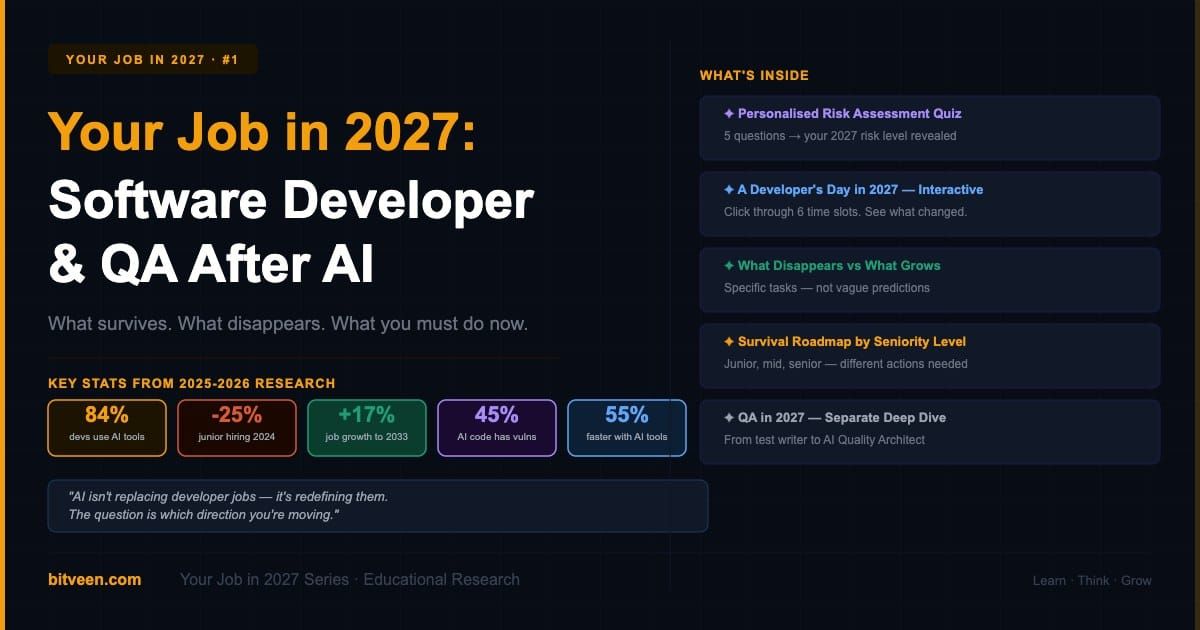
84% of developers use AI. 25% of junior roles are already gone. Here's exactly what survives, what disappears, and what you need to do — with a personalised risk assessment and a day-in-the-life walkthrough of 2027.

The Question Everyone Is Actually Asking
Not "will AI take my job?" — that's the headline version.
The real question is: "Which parts of my job will survive, which parts will disappear, and what do I need to do about it right now?"
This is the first in our "Your Job in 2027" series — where we answer that question role by role, using actual research and data, not speculation.
We start with Software Developers and QA Engineers — the people closest to AI adoption, and therefore the first to show us what's coming for everyone else.
The Numbers First — Because They're Surprising
- 84% of developers now use AI tools in their daily work — up from 15% in 2023 (Stack Overflow, 2025)
- 65% expect their role to be fundamentally redefined by end of 2026 (WEF, January 2026)
- 25% drop in junior developer hiring year-over-year in 2024 (Stack Overflow)
- 17% projected job growth for software engineering overall through 2033 — net positive, not negative (BLS)
- 20% decline in employment for developers aged 22–25 since their 2022 peak (Stanford Digital Economy Lab, 2025)
How can hiring drop and job growth be positive at the same time? Because AI is eliminating certain types of developer work — not developers entirely. The work that survives is harder, more valuable, and pays more.
First — Where Do You Stand? Take the Risk Check
Is Your Developer Role at Risk?
5 quick questions. Get an honest assessment of where you stand.
What's Already Gone (or Going Fast)
For Software Developers:
- Boilerplate code generation — CRUD operations, API scaffolding, standard data models. GitHub Copilot, Cursor, and Claude handle this in seconds.
- Unit test writing — AI generates full test suites from function signatures. What took a day now takes minutes.
- Basic debugging — "Why is this null?" type bugs. AI tools catch these before you even run the code.
- Documentation first drafts — JSDoc, README files, API docs. Auto-generated and reasonably good.
- Standard algorithm implementation — Sorting, searching, common data structure operations. Solved by autocomplete.
For QA Engineers:
- Manual regression test case writing — AI generates these from existing code automatically.
- Happy-path test execution — Automated end-to-end testing tools now cover the standard flows without human effort.
- Bug reporting for obvious issues — Static analysis tools catch these before QA sees the code.
- Test data generation — AI creates realistic synthetic datasets on demand.
A Developer's Day in 2027 — Click Through
A Developer's Day in 2027 — Step by Step
Watch how the job looks different. Some tasks are gone. Others are more important than ever.
What Grows in Value — The Survivor Skills
For Software Developers:
- System architecture & design — Deciding how components connect, scale, and recover from failure. AI can suggest patterns but cannot understand your specific business constraints.
- AI code review & security auditing — 45% of AI-generated code contains critical security vulnerabilities. Someone has to catch them. This is now a premium skill.
- Stakeholder communication & requirements translation — Turning ambiguous human needs into precise system specifications. AI cannot sit in a room with a confused client and figure out what they actually want.
- AI tool orchestration — Knowing which AI tool to use for which task, how to prompt effectively, and how to chain tools together. The new developer superpower.
- Domain expertise — Deep understanding of FinTech, HealthTech, LegalTech etc. combined with coding. AI can code anything but understands nothing.
For QA Engineers:
- AI test strategy — Deciding what AI test tools to run, what they miss, and how to design test coverage for non-deterministic AI outputs.
- Edge case engineering — AI covers 70% of happy paths but misses 60% of edge cases. Finding those edges is now the core QA skill.
- Quality ownership — Moving from "does this test pass?" to "does this system behave correctly for users?" — a fundamentally higher-level question.
- AI output validation — Testing software that itself uses AI. When an AI model's response varies, what does pass/fail even mean? QA engineers are defining this.
The Survival Roadmap — Concrete Steps, Not Vague Advice
If you're a junior developer (0–3 years): The hardest truth first — the traditional junior pathway (write boilerplate, slowly earn more responsibility) is compressed. What took 3 years now has to happen in 1. Start working on system design immediately, even if your job doesn't require it yet. Contribute to architecture discussions. Understand why decisions are made, not just how to implement them.
- This week: Take one task you'd normally code from scratch. Use AI to generate it. Your job: review it, find its flaws, improve it. Practice this every day.
- This month: Study one system design concept (load balancing, caching, database indexing). Apply it to something at work even if no one asked you to.
- This quarter: Pick a domain. Become the person on your team who understands the business problem, not just the code. Attend product meetings.
If you're a mid-level developer (3–7 years): You're in the best position — experienced enough to direct AI, not yet pigeonholed. The risk is complacency.
- Own one AI tool deeply — become the team expert in Copilot, Cursor, or Claude for code. Run internal workshops.
- Shift 20% of your time to review — volunteer to review AI-generated PRs. This builds the skill that's becoming most valuable.
- Get security knowledge — OWASP Top 10 at minimum. Understand the vulnerabilities AI introduces.
If you're a senior developer (7+ years): Your biggest risk is not AI replacing you — it's junior developers augmented by AI catching up to your output speed while companies wonder why they need both of you.
- Define architecture — Make explicit what only experience can provide. Document decisions, patterns, and context.
- Become the AI governance person — Who decides which AI tools the team uses? What's the review policy? You should own this.
- Mentor the transition — Teams that navigate AI adoption well have senior people leading the change, not resisting it.
The One-Sentence Summary
Software development isn't shrinking — it's bifurcating: the bottom (boilerplate coding) is collapsing, and the top (architecture, judgment, security, domain expertise) is exploding. The question is which direction you're moving.
What's Next in "Your Job in 2027"
Next up: Data Analyst & Business Intelligence — where dashboards are being replaced by AI-generated insights, and what that means for the 5 million people in this role globally.
YOUR JOB IN 2027 · SERIES — CLICK TO READ
💻 Software Developer & QA 📍 You are here 📊 Data Analyst & BI 🏦 Bank Cashier, Teller & Manager 🤝 HR & Recruitment Specialist ✍️ Content Writer & Marketing ManagerDISCLAIMER
This article is for educational and informational purposes only. Job market predictions are based on current research, surveys, and trend analysis as of 2025–2026. No prediction about the future can be guaranteed. Individual outcomes will vary based on skills, industry, company, geography, and many other factors. This is not career or professional advice. Please consult qualified career professionals before making major career decisions. Bitveen.com is not responsible for any career decisions made based on this content.