Your Job in 2027: HR & Recruitment Specialist After AI
AI adoption in HR doubled in one year. 87% of companies use AI hiring tools. But 93% of managers say humans are still essential — just for different things.

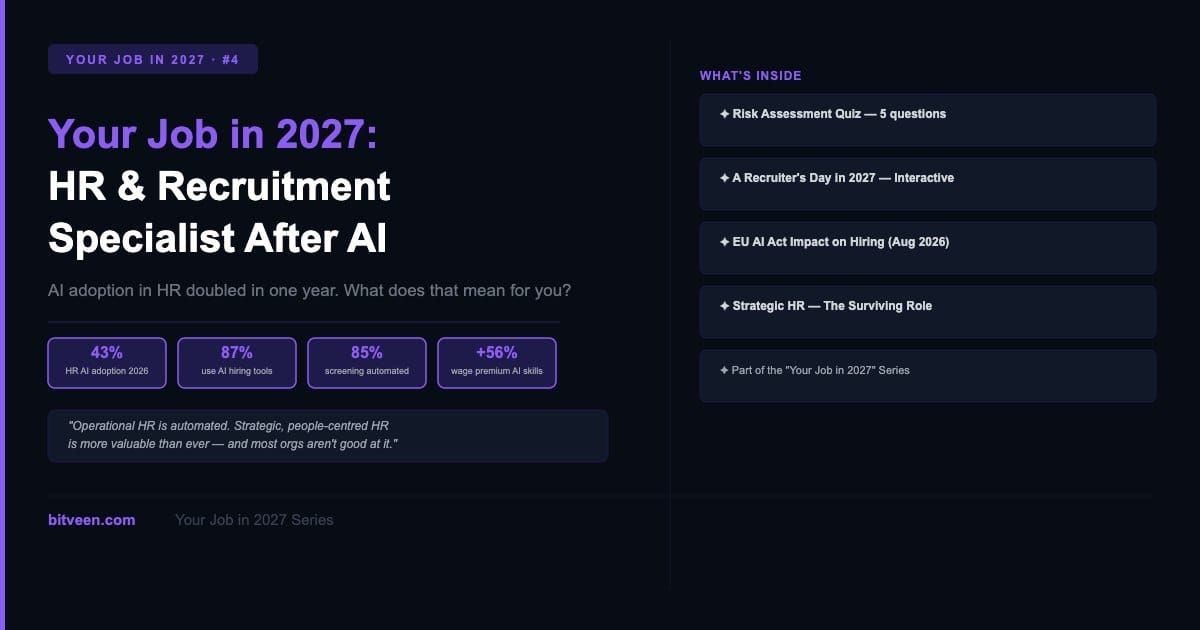
AI Doubled Its HR Adoption in One Year. Recruiters, Take Note.
In 2024, 26% of organisations used AI for HR tasks. By 2025, that number was 43% — a near-doubling in 12 months (SHRM). In 2026, that figure continues to climb.
This isn't gradual adoption. It's a step-change. And for HR professionals and recruiters, the implications are very specific.
The good news: 93% of hiring managers still say human involvement is essential. The uncomfortable truth: the human involvement they still need is not the part most recruiters are currently doing.
The Numbers That Matter
- 43% of organisations now use AI for HR tasks — up from 26% in 2024 (SHRM)
- 87% of companies now use AI-driven hiring tools (Demandsage)
- 99% of Fortune 500 companies have AI in their hiring tech stack
- 85% of recruitment screening expected to be automated by 2026–2027 (Demandsage)
- 66% of US adults say they'd avoid applying for jobs where AI makes hiring decisions — creating a compliance and trust problem for every HR team
- 78% accuracy with which AI skill-matching now predicts job performance (Second Talent, 2025)
- 56% wage premium for HR professionals with AI skills vs those without (PwC AI Jobs Barometer)
First — Where Do You Stand?
Is Your HR Role at Risk?
5 questions. Your honest 2027 assessment.
A Recruiter's Day in 2027 — Click Through
A Recruiter's Day in 2027
The hiring pipeline has changed completely. Click through each stage.
What's Automated in HR & Recruitment
- CV screening and ranking — AI tools parse, score, and rank applications before any human sees them. 50x faster, more consistent, but legally regulated as 'high risk' under EU AI Act.
- Interview scheduling — Fully automated. AI checks calendars, proposes slots, sends confirmations, handles rescheduling.
- Job description writing — AI generates, optimises for inclusivity, adjusts for search visibility.
- Initial candidate outreach — Personalised messages sent at scale. 5–12% higher response rates with AI-personalised outreach (LinkedIn).
- Benefits administration — 90% of benefits administration functions expected to be automated by 2027 (Demandsage).
- Payroll processing — Already largely automated at most mid-size organisations.
What Grows in Value
- AI bias auditing — The EU AI Act requires annual independent bias audits of all AI hiring tools. NYC's Local Law 144 already mandates this. Someone in HR needs to own this — and most organisations haven't started.
- Candidate experience — When AI screens everyone, the human moment matters more. The recruiter who connects, builds trust, and helps candidates navigate the process has irreplaceable value.
- Workforce strategy and planning — Which roles will exist in 3 years? Which skills are becoming obsolete? How should we structure teams? These are board-level questions that require senior HR judgment.
- Employee relations and wellbeing — Conflict resolution, performance support, mental health conversations. AI cannot navigate these. HR professionals who are skilled here are permanently safe.
- Employment law and AI compliance — As AI permeates every hiring process, the legal landscape is expanding rapidly. HR professionals with regulatory expertise are premium.
The Survival Roadmap
If you're an early-career HR professional or recruiter:
- Stop spending more than 2 hours a day on CV screening. Learn your company's AI tools and let them do it.
- Invest that time in candidate relationships — be the human in a world of AI processes.
- Learn about EU AI Act and NYC Local Law 144. Understanding AI compliance in hiring is a growing specialism.
If you're a mid-level HR manager:
- Own the AI governance conversation at your company. Run an audit of the bias risks in your current screening tools.
- Build workforce planning capability — learn to use predictive attrition and skills gap tools.
- Position yourself as the bridge between AI efficiency and human-centred culture.
If you're an HR Director or CHRO:
- The question isn't whether to use AI in HR — it's how to use it responsibly and compliantly.
- Define your organisation's AI ethics policy for hiring before regulation forces one on you.
- Invest in strategic workforce planning capability — this is the role of HR at the board table.
The One-Sentence Summary
Operational HR is being automated. Strategic, people-centred, and compliant HR is more valuable than ever — and most organisations are not yet good at it.
What's Next in "Your Job in 2027"
Final in the series: Content Writer & Marketing Manager After AI — where 50% job decline is projected in some content roles, yet the creative strategist has never been in more demand.
YOUR JOB IN 2027 · SERIES — CLICK TO READ
💻 Software Developer & QA 📊 Data Analyst & BI 🏦 Bank Cashier, Teller & Manager 🤝 HR & Recruitment Specialist 📍 You are here ✍️ Content Writer & Marketing ManagerDISCLAIMER
This article is for educational and informational purposes only. Statistics are from public research sources and may change. Individual outcomes vary. This is not professional HR or career advice. Bitveen.com is not responsible for decisions made based on this content.