Your Job in 2027: Data Analyst & BI After AI
AI writes the SQL, builds the dashboard, and generates the report. So what does the data analyst actually do in 2027? The answer is more demanding — and better paid — than before.

The Dashboard Is Writing Itself. Now What?
A few years ago, a data analyst's most valuable skill was the ability to pull, clean, and visualise data. Companies needed people who could navigate databases, build dashboards, and turn raw numbers into readable reports.
Today, tools like Tableau Pulse, Looker AI, and Microsoft Copilot for Excel can do that automatically. They write the SQL. They build the dashboard. They even write the narrative explanation in plain English.
So if AI is doing the dashboard, what exactly is the data analyst doing?
The answer is more interesting — and more demanding — than the job used to be. Here's what the research actually shows.
The Numbers — Contradictions Worth Understanding
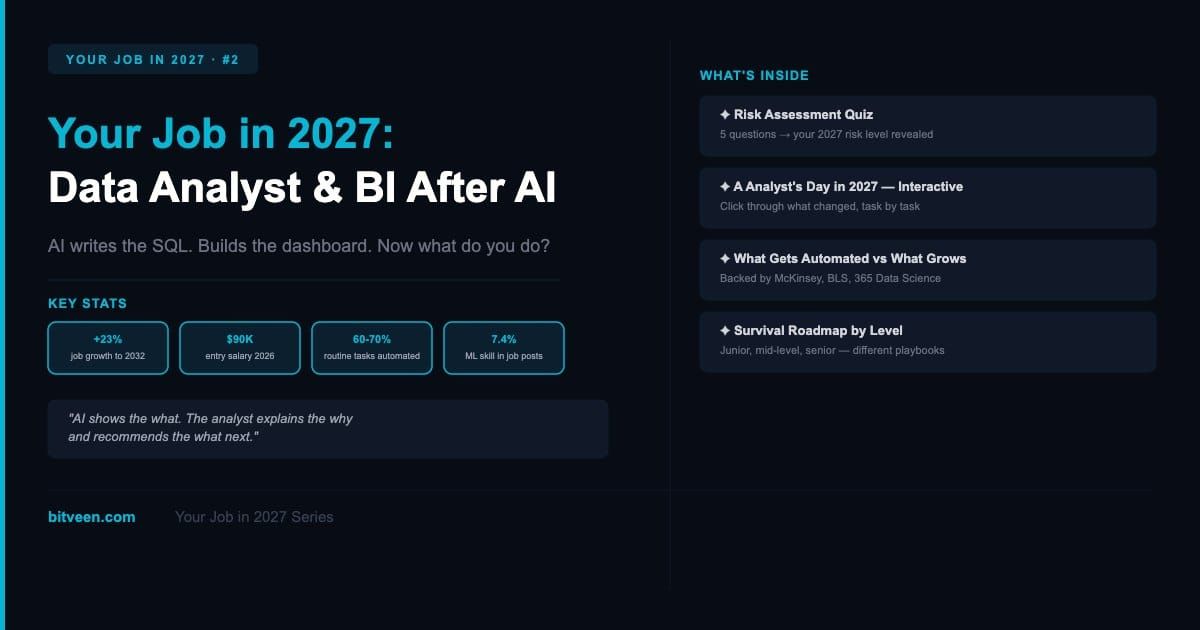
- 23% job growth projected for data analysts through 2032 — one of the fastest-growing roles (BLS)
- $90,000 average entry-level salary in 2026 — up $20,000 from 2024 (365 Data Science)
- 60–70% of routine data tasks (cleaning, querying, reporting) automatable by 2026 (McKinsey)
- $104 billion global data analytics market by end of 2026, growing at 21.5% annually
- 7.4% of all 2026 data analyst job postings specifically require machine learning skills — up from near zero in 2022
The paradox: routine data work is being automated, yet the profession is growing and salaries are rising. The explanation is simple: the work that survives is harder, rarer, and more valuable.
First — Where Do You Stand?
Is Your Data Analyst Role at Risk?
5 quick questions. Get your honest 2027 assessment.
What AI Is Already Doing in Data Analytics
- SQL generation — Microsoft Copilot and Google Gemini write complex queries from plain English prompts. "Show me last quarter's revenue by region, broken down by customer segment" → instant SQL.
- Automated reporting — Tableau Pulse generates weekly narrative summaries automatically. The report writes itself, emails itself, and explains itself.
- Basic predictive models — AutoML platforms (Google AutoML, Azure AutoML, H2O) build and deploy forecasting models without data science expertise.
- Data cleaning — AI tools detect anomalies, fill missing values, and standardise formats in minutes rather than hours.
- Dashboard building — Natural language to dashboard tools (ThoughtSpot, Looker) let non-technical stakeholders build their own views.
Critical implication: if your stakeholders can now self-serve their own dashboards, your value as a 'report builder' is near zero. The analyst who only builds reports is the analyst who gets restructured first.
A Data Analyst's Day in 2027 — Click Through
A Data Analyst's Day in 2027
Same title. Completely different job. Click through each moment.
What Grows in Value — The Survivor Skills
- Insight generation over report generation — AI shows the 'what'. You explain the 'why' and recommend the 'what next'. This requires understanding the business deeply enough to contextualise any data point.
- Predictive and prescriptive analytics — Moving from 'what happened' to 'what will happen' and 'what should we do'. AutoML makes models accessible, but interpreting and validating them requires a human.
- AI output auditing — AI models hallucinate, carry biases, and make errors that look credible. Someone with statistical knowledge and business judgment needs to catch these. New title emerging: AI Audit Analyst.
- Data product management — Treating data as a product that serves internal customers. Deciding what data to collect, how to structure it, and how to make it accessible. A strategic, cross-functional role.
- Business partnering — Being present at strategic decisions, not just sending reports after. The analyst who advises the VP of Strategy is irreplaceable. The analyst who emails PDFs is not.
- Data ethics and governance — As AI uses company data in more ways, someone needs to own questions of privacy, bias, consent, and compliance. Analysts with governance skills are increasingly rare and valuable.
The Survival Roadmap
If you spend more than 3 hours a day on reporting and SQL:
- Automate your top 5 recurring reports this month. Use Tableau Pulse, Power BI Copilot, or even a Python script.
- Invest the saved time in stakeholder relationships — attend product and strategy meetings even if uninvited.
- Take one AutoML course (Google, Azure, or DataRobot have good free resources).
If you're already past basic reporting:
- Go deeper on predictive analytics — own one model end to end, including business recommendation.
- Learn one governance framework — GDPR for data, or your industry's specific regulatory context.
- Build relationships with product and strategy teams. Become the person they call, not the person they email.
If you're a senior analyst:
- Define what 'AI-generated analysis' means for your team's quality standards.
- Build a data product — something that serves the business on an ongoing basis without being rebuilt each time.
- Position yourself as the bridge between AI capabilities and business strategy. This is the highest-value role in analytics.
The One-Sentence Summary
Data analysts who build reports are becoming obsolete. Data analysts who interpret, predict, and advise are becoming more valuable than ever.
What's Next in "Your Job in 2027"
Next: Bank Cashier, Teller & Manager After AI — where 54% of banking jobs face automation risk, but the human skills that survive are very specific.
YOUR JOB IN 2027 · SERIES — CLICK TO READ
💻 Software Developer & QA 📊 Data Analyst & BI 📍 You are here 🏦 Bank Cashier, Teller & Manager 🤝 HR & Recruitment Specialist ✍️ Content Writer & Marketing ManagerDISCLAIMER
This article is for educational and informational purposes only. All statistics and projections cited are from public research sources and may change. Individual outcomes will vary significantly based on industry, geography, company, and personal skills. This is not professional career advice. Consult qualified professionals before making major career decisions. Bitveen.com is not responsible for career decisions made based on this content.