Micro Distribution Hub: The Hidden Business Opportunity in Tier-2 & Tier-3 Cities
A Micro Distribution Hub manages storage, packing & delivery so brands focus on sales. Faster dispatch, lower costs, better efficiency—helping businesses scale smoothly. #Logistics #Startup #D2C #Ecommerce #SupplyChain

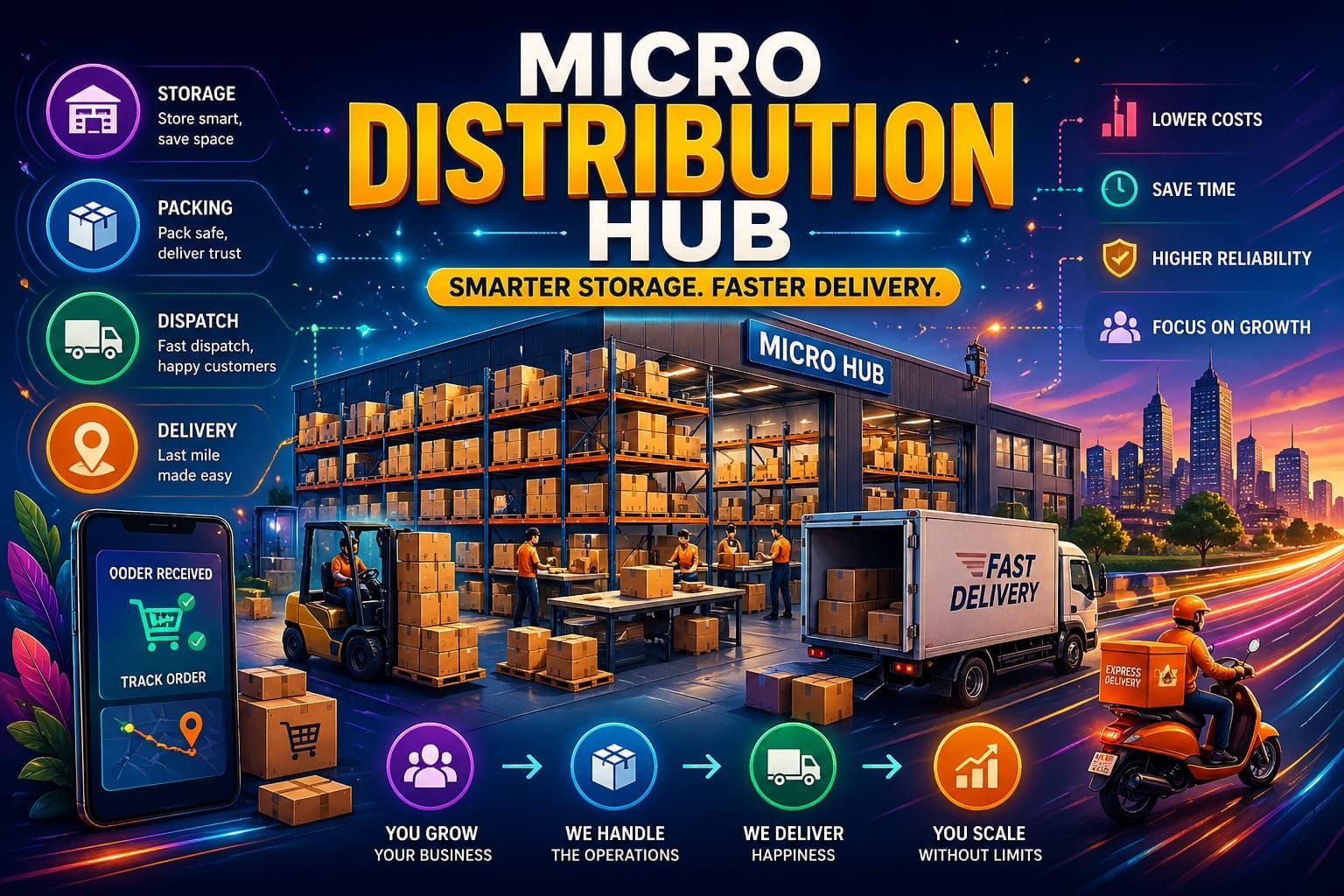
In the last few years, India has seen a massive rise in small businesses—Instagram sellers, home-based brands, D2C startups, and local manufacturers.
But while selling has become easier, one major problem still exists:
Storage, packing, and delivery are still messy, inefficient, and time-consuming.
This is where a Micro Distribution Hub comes in—a simple yet powerful business model that solves a real problem.
What is a Micro Distribution Hub?
A Micro Distribution Hub is a small, localized warehouse that provides:
- Storage space
- Order packing
- Dispatch handling
- Optional last-mile delivery
Instead of businesses managing these operations themselves, they outsource everything to a centralized hub.
Think of it as a “mini logistics center” for small businesses.
Why This Business is Growing Fast
1. Explosion of Small Sellers
Thousands of sellers operate through:
- Local marketplaces
- Amazon / Flipkart
Most of them don’t have proper infrastructure.
2. Pain Points You Solve
Small businesses struggle with:
- Storing inventory at home
- Managing orders manually
- Packing delays
- Delivery coordination
A Micro Distribution Hub removes all of this.
3. Rise of Convenience Economy
Today, businesses want to focus on:
“Selling more, not managing operations.”
If you handle operations, they are happy to pay.
How the Business Works
Step 1: Onboard Clients
You partner with:
- Local sellers
- D2C brands
- Food businesses
- E-commerce sellers
Step 2: Store Their Inventory
You allocate rack space for each client.
Step 3: Process Orders
When orders come:
- Pick items
- Pack
- Dispatch
Step 4: Deliver (Optional)
You can:
- Tie up with delivery partners
- Or build your own delivery network
Revenue Model
A Micro Distribution Hub earns in multiple ways:
1. Storage Fee
Monthly charge per client
(₹3,000 – ₹10,000)
2. Order Handling Fee
Per order packing & dispatch
(₹10 – ₹30 per order)
3. Delivery Margin
Extra margin on deliveries
(₹10 – ₹25 per order)
Example
- 5 clients × ₹5,000 = ₹25,000
- 100 orders/day × ₹15 × 30 days = ₹45,000
- Delivery margin = ₹20,000
Total ≈ ₹70,000 – ₹1,00,000/month (early stage)
Why This Business is Powerful
✅ No Inventory Risk
You don’t own goods.
✅ Recurring Income
Monthly clients = stable revenue.
✅ Scalable Model
Add more clients → more revenue
Open more hubs → expand network
✅ Low Operational Complexity
Compared to manufacturing or retail.
Who Should Start This?
This business is ideal for:
- People with small commercial space
- Tech-savvy individuals
- Those looking for a side business
- Entrepreneurs who prefer systems over manual work
Biggest Challenges
1. Getting Initial Clients
Without clients, the hub is just empty space.
Solution:
Start by onboarding 2–3 clients before setup.
2. Inventory Management
Mismanagement can break trust.
Solution:
Use simple tracking systems (even Excel to start).
3. Low Margins Initially
You need volume to grow.
Solution:
Focus on long-term, recurring clients.
How This Becomes a Big Business
This is not just a warehouse business.
It can evolve into:
- Multi-location hub network
- Local logistics brand
- Delivery platform
- SaaS product for warehouse management
You start small, but the model is highly scalable.
Final Thoughts
A Micro Distribution Hub is one of those businesses that:
- Solves a real problem
- Requires relatively low investment
- Can scale over time
- Works especially well in growing cities
While others chase trendy startup ideas, this is a ground-level opportunity with real demand.
Sometimes, the biggest opportunities are not glamorous—they are simply practical, scalable, and needed.
Next, let's talk about.
Ground-level, step-by-step actions (Bonus)
A micro distribution hub is easy to set up.
Getting clients is the real game.
🎯 First Principle (Don’t skip this)
❌ Don’t build warehouse first
✅ Get 2–3 paying clients first → then set up
Otherwise you’ll sit with empty racks.
🧭 STEP 1 — Define your first target (VERY important)
Don’t target everyone.
Start with ONLY ONE segment:
Best starting segment:
- Instagram sellers (clothes, cosmetics, gifting)
- Home bakers / food brands
- Small Amazon sellers
Why?
- Already selling
- Already struggling with packing/delivery
- Easy to approach
🔍 STEP 2 — Find 50 potential clients (in 2 days)
Method 1 — Instagram search (MOST POWERFUL)
Search:
- “Indore boutique”
- “Indore homemade cakes”
- “Indore handmade products”
- “Indore clothing brand”
👉 Open profiles
👉 Check:
- Active posts
- Comments/orders
- Phone number / WhatsApp
Make a list of 50 sellers
Method 2 — Google Maps
Search:
- “home bakery”
- “small clothing store”
- “cosmetics shop”
Collect numbers.
Method 3 — Amazon / Flipkart
Search:
- “Indore seller”
Find small brands → contact via Instagram/Google.
📞 STEP 3 — First outreach (don’t pitch like business)
Don’t say:
❌ “I run warehouse, give me business”
Say this 👇
WhatsApp / DM Script
Hi, I saw your products on Instagram.
Quick question — how do you currently manage packing and delivery?
(Wait for reply)
Then:
I’m working on helping local sellers handle storage + packing + delivery so they can focus only on selling.
Wanted to understand your current challenges.
👉 This is NOT selling
👉 This is conversation
🧠 STEP 4 — Understand their pain (this is gold)
Ask:
- Where do you store inventory?
- How much time goes in packing?
- Delivery issue?
- Returns issue?
- Order management issue?
Listen carefully.
You will hear same problems again and again.
💡 STEP 5 — Pitch solution (custom, not generic)
Now say:
If I handle your storage + packing + dispatch, and you only focus on orders… would that help?
Then:
I’m starting with 2–3 sellers only.
Want to test this model.
👉 Scarcity + early access
💰 STEP 6 — Close first client (very important strategy)
Don’t go for big money first.
Offer:
- Free 7 days trial
OR - Low price first month
Example:
₹3000/month + ₹10/order (intro offer)
Your goal = proof, not profit
🚚 STEP 7 — Deliver manually first (NO FULL SETUP)
Before full setup:
- Use temporary space
- Manage 1 client manually
- Learn real operations
This is your real MBA.
🔁 STEP 8 — Get 3 clients → then build setup
Only after:
- 2–3 paying clients
- Regular orders
Then:
- Buy racks
- Hire 1 staff
- Set system
📢 STEP 9 — Build trust & proof
Once you have 1–2 clients:
- Take testimonials
- Show packing videos
- Show process
Now selling becomes easier.
⚡ STEP 10 — Scale outreach
Now repeat:
- Contact 10 sellers daily
- Close 1 per week
Within 2–3 months:
👉 10–15 clients possible
🔥 Pro tips (real ones)
1. Focus on messy sellers
Not big brands.
Target:
- Disorganized
- Growing fast
- Struggling
2. Visit physically (huge advantage)
Go to:
- small shops
- bakeries
- home businesses
India = trust = face-to-face
3. Solve 1 problem first
Not everything.
Start with:
packing + dispatch only
Then add storage, delivery later.
4. Speed = your USP
If you say:
same-day dispatch
You win instantly.
❌ Biggest mistake people do
- Build warehouse first
- Spend money
- Wait for clients
This fails 90% of time.
Reality check
You don’t need:
- Big warehouse
- Big investment
- Fancy software
You need:
First 3 clients
That’s it.