Blog 5: Space Complexity Explained (Memory Matters Too)
Space Complexity measures how much memory your algorithm uses as input grows. Learn O(1) vs O(n), recursion stack usage, and time vs space trade-offs with simple examples and diagrams. Write efficient and optimized code for interviews. #DSA #SpaceComplexity #Algorithms #Programming #Coding #Tech

Introduction
In the previous blog, we learned how fast an algorithm runs (Time Complexity).
Now the next question is:
How much memory does your solution use?
Because in real-world systems, memory is limited.
👉 This is where Space Complexity comes in.
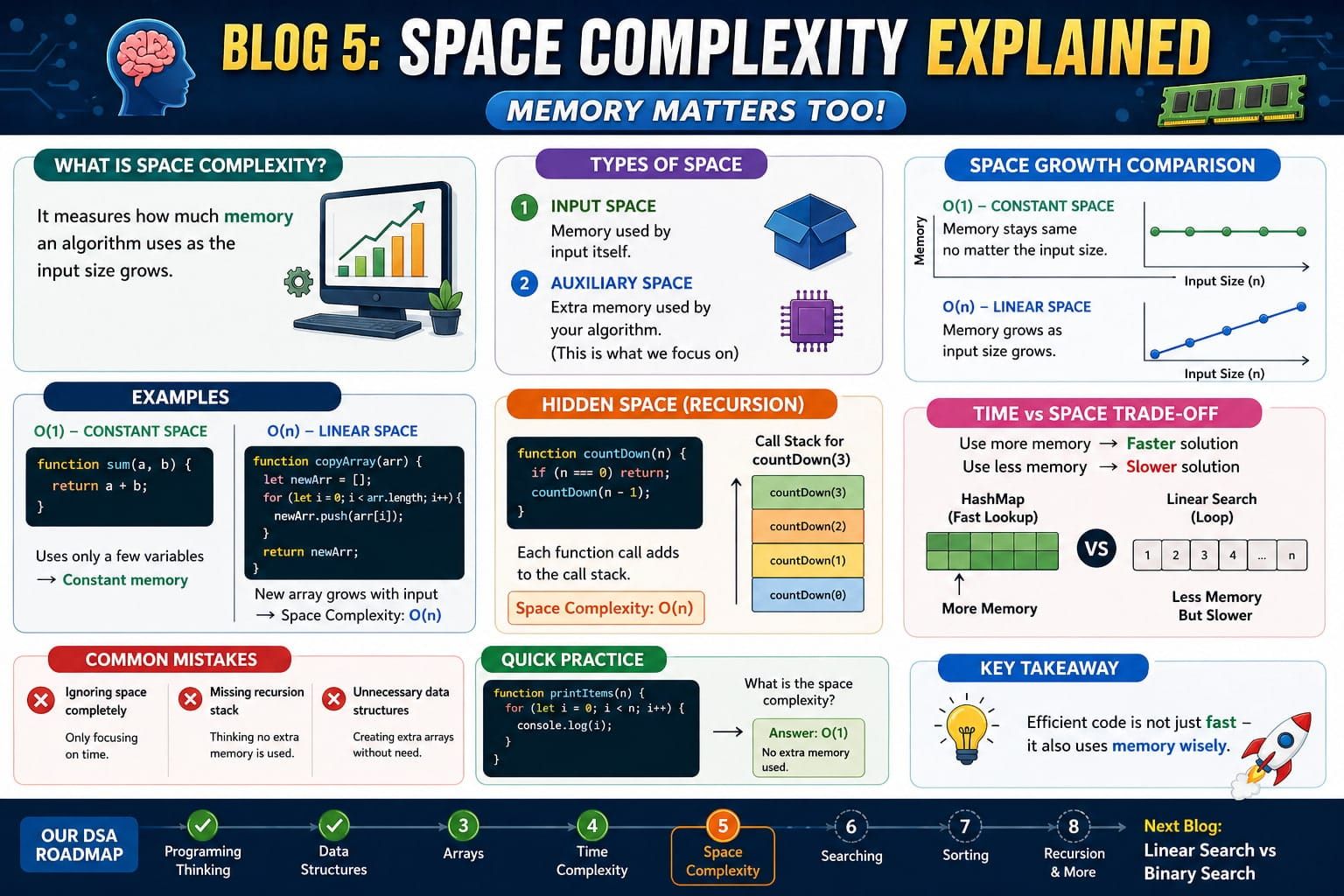
⚡ What is Space Complexity?
Space Complexity measures:
How much memory an algorithm uses as input size grows
It includes:
- Variables
- Data structures
- Function calls
🧊 Simple Intuition
Think of it like packing a bag 🎒
- Fewer items → less space
- More items → more space
👉 Same logic applies to programs
📦 Types of Space
1. Input Space
- Memory used by input itself
- Usually not counted in optimization
2. Auxiliary Space (Important)
Extra memory used by your algorithm
👉 This is what we focus on
📊 Basic Examples
🔹 O(1) — Constant Space
function sum(a, b) {
  return a + b;
}
👉 Uses only a few variables → constant memory
🔹 O(n) — Linear Space
function copyArray(arr) {
  let newArr = [];

  for (let i = 0; i < arr.length; i++) {
    newArr.push(arr[i]);
  }

  return newArr;
}
👉 New array grows with input → O(n)
📉 Visual Growth Comparison (Space)
Input Size (n) →
--------------------------------------------------------------

O(1)
→  ●────────●────────●────────●
   memory stays same (few variables only)

O(n)
→  ●────●────────●──────────●
   memory grows with input size (extra array/list)
🔁 Hidden Space (Very Important)
Even if you don’t create arrays…
👉 Recursion uses memory internally
function countDown(n) {
  if (n === 0) return;

  countDown(n - 1);
}
👉 Each call adds to call stack
countDown(3)
→ countDown(2)
→ countDown(1)
→ countDown(0)
👉 Space Complexity: O(n)
⚖️ Time vs Space Trade-Off
Sometimes you can:
- Use more memory → faster solution
- Use less memory → slower solution
Example:
- HashMap → fast lookup, more memory
- Loop search → less memory, slower
⚠️ Common Mistakes
❌ Ignoring space completely
Only focusing on time
❌ Missing recursion stack
Thinking no extra memory is used
❌ Unnecessary data structures
Creating extra arrays without need
🎯 Interview Insight
Interviewers don’t just check correctness.
They often ask:
“Can you reduce space complexity?”
This means:
- Are you using extra memory unnecessarily?
- Can you solve the same problem without extra arrays or data structures?
Example
❌ Approach 1 (O(n) space)
function doubleArray(arr) {
  let result = [];

  for (let i = 0; i < arr.length; i++) {
    result.push(arr[i] * 2);
  }

  return result;
}
👉 Extra array created → O(n) space
✅ Approach 2 (O(1) space)
function doubleArray(arr) {
  for (let i = 0; i < arr.length; i++) {
    arr[i] = arr[i] * 2;
  }

  return arr;
}
👉 Modified in-place → O(1) space
🎯 Key Insight
If you avoid extra storage and modify existing data → space reduces
⚖️ Follow-up Interview Question
“Can you solve it in O(1) space?”
This means:
- Use no extra memory
- Only a few variables allowed
👉 This is called in-place solution
Quick Practice
Code:
function printItems(n) {
  for (let i = 0; i < n; i++) {
    console.log(i);
  }
}
What is Space Complexity?
Let’s break it:
i→ one variable- No array, no extra storage
- Loop runs many times, but memory does NOT increase
Final Answer:
O(1) — Constant Space
⚠️ Important Understanding
Loop running n times ≠ O(n) space
Because:
- Time is increasing
- Memory is NOT increasing
Golden Rule
Time Complexity depends on how many steps run.
Space Complexity depends on how much extra memory is used.
🚀 What’s Next?
Now that you understand both:
Next blog:
“Linear Search vs Binary Search (Complete Understanding)”
✍️ Closing Thought
“Efficient code is not just fast — it also uses memory wisely.”