🚚 What Is the Potential of Tata Motors Commercial Business?
Tata Motors' commercial vehicle business is positioned for strong growth driven by logistics demand, infrastructure expansion, electric mobility and global markets. Know its long-term potential, key drivers, and risks before investing. #TataMotors #CVMarket #Investment

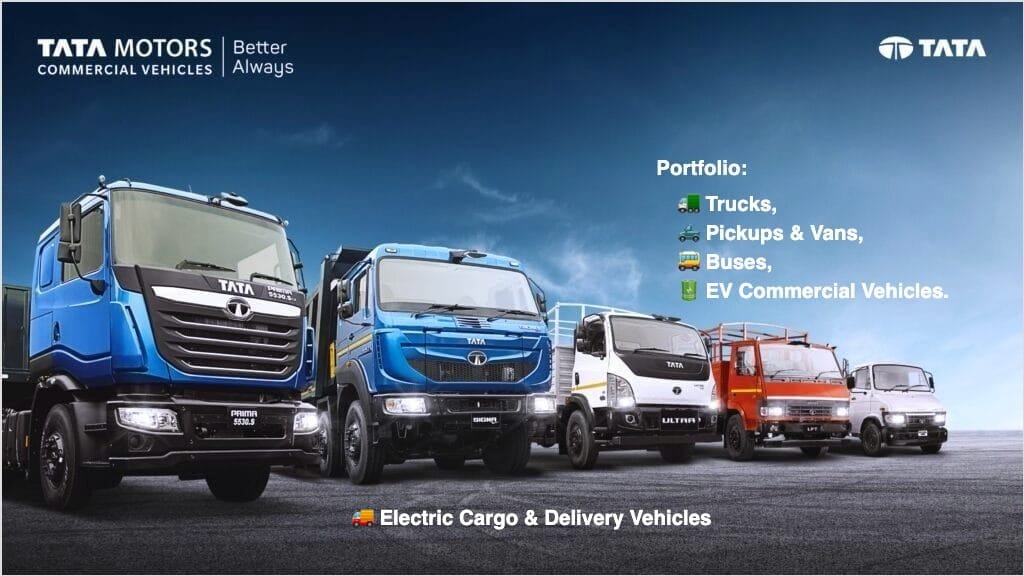
Tata Motors is one of India’s largest commercial vehicle (CV) manufacturers, commanding a strong presence across trucks, buses, pickups and utility vehicles. Its commercial business is not just defensive (steady revenues) — it has growth potential from multiple structural trends in India and globally.
Let’s break down what makes Tata Motors Commercial Business significant and what its future potential looks like.
📌 1. Market Leadership in India
Tata Motors is the #1 commercial vehicle brand in India in many segments:
- Majority market share in trucks and buses
- Leadership in light commercial vehicles (LCVs)
- Strong dealer and service network across urban and rural India
Being market leader gives advantages in:
✅ Brand recall
✅ Scale economics
✅ Pricing power
✅ After-sales and spare parts revenue
These structural benefits support consistent cash flows and margins.
📈 2. Strong Domestic Demand Drivers
Several macro trends support long-term CV demand in India:
📦 Growth in Logistics & E-commerce
With rising e-commerce and faster fulfillment expectations, demand for last-mile and mid-mile logistics vehicles is increasing.
🏗️ Infrastructure Investment
Road projects and construction activity directly fuel demand for heavy trucks and tipper segments.
🌾 Rural & Agri Demand
Trucks and utility vehicles are increasingly used for agricultural logistics during harvest seasons.
📍 Tier-2/3 City Growth
As secondary cities grow, so does demand for local transportation and freight movement.
Result: Commercial vehicle volumes are likely to remain strong over the next 5–10 years.
📊 3. Product Portfolio Expansion
Tata Motors has been expanding its commercial portfolio:
🚛 Trucks
- Entry-level
- Medium
- Heavy duty
🛻 Pickups & Vans
Growing demand in small businesses and e-commerce delivery.
🚌 Buses
Urban mobility solutions; electric buses (EV) are a key growth opportunity.
🔋 EV Commercial Vehicles
Electric buses and cargo vehicles — an emerging segment with government support and zero-emission objectives.
This diversified portfolio reduces dependence on one segment and captures multiple growth pockets.
🟢 4. EV Opportunity in Commercial Vehicles
Electric commercial vehicles are gaining traction globally and in India:
🚌 Electric Buses
Tata Motors is one of the key suppliers of e-buses to state transport undertakings and private players.
🚚 Electric Cargo & Delivery Vehicles
Urban delivery fleets are shifting toward EVs for lower operating cost and compliance with emission norms.
⚡ Government Incentives
FAME and state EV policies provide subsidies and support for EV adoption.
Commercial EVs = higher margins + recurring service revenue + future mobility relevance.
🌍 5. Exports & Global Reach
Tata Motors isn’t just India-centric:
- Commercial vehicles exported to Africa, Middle East, South Asia and more
- Export volumes provide diversification against domestic cycles
- Global presence enhances brand and hedges regional slowdowns
💼 6. After-Sales & Services Economics
Commercial business isn’t just about vehicle sales.
🚗 Spare parts
🛠️ Maintenance contracts
📍 Network services
📦 Fleet uptime solutions
These provide recurring, high-margin revenue — sometimes more profitable than the initial vehicle sale.
📉 7. Risks to Consider
Potential isn’t risk-free:
❗ Cyclical nature of CV demand
❗ Commodity cost fluctuations (steel, aluminum)
❗ Interest rate sensitivity (fleet financing costs)
❗ Regulatory changes (emission norms, safety policies)
But Tata Motors’ market leadership and diversification help balance these risks.
📊 8. What Analysts Generally Expect
While precise numbers vary, here is a directional outlook:
🔹 Steady domestic volume growth supported by logistics, infrastructure and rural demand
🔹 EV commercial vehicles becoming a notable growth pillar by late 2020s
🔹 After-sales and service revenue growing faster than new vehicle sales
🔹 Exports as a stabilizing force during domestic slowdown periods
In simple terms:
📈 Growth + Stability + Diversification = Strong long-term potential
⭐ Final Thought
Tata Motors’ commercial business isn’t just surviving — it’s strategically positioned for growth due to:
✔️ Leadership in India
✔️ Diverse product mix
✔️ EV transition
✔️ Supportive macro trends
✔️ After-sales revenue streams
✔️ Export markets
If India continues to grow its economy, infrastructure, logistics, and EV adoption — Tata Motors Commercial Business stands to benefit significantly over the next 5–10 years.
⚠️ Disclaimer
This article is intended solely for educational and informational purposes.
It should not be considered financial advice, investment guidance, or a recommendation to buy or sell any security.
The commercial vehicle industry is cyclical, and the future performance of Tata Motors or any company may be affected by economic conditions, policy changes, commodity price fluctuations, geopolitical factors, and market volatility.
Always assess your risk tolerance, financial goals, and investment horizon, and consult a registered financial advisor before making any investment decisions.
Investing involves risks, including the possible loss of capital.