Blog 4: Time Complexity Explained Simply (Big-O Made Easy)
Time Complexity helps you measure how fast your code runs as input grows. Learn Big-O notation, understand O(1), O(n), O(log n), and O(n²) with simple examples and diagrams. Write efficient code and crack coding interviews. #DSA #BigO #TimeComplexity #Algorithms #Coding #Tech

🧠 Introduction
You wrote a solution. It works. ✅
But here’s the real question:
Will it still work efficiently when input becomes very large?
Handling 10 inputs is easy.
Handling 10 lakh inputs is where real skill shows.
👉 This is why we need Time Complexity.
⚡ What is Time Complexity?
Time Complexity measures:
How the execution time of an algorithm grows with input size
👉 Important:
- It does NOT measure exact seconds
- It measures growth pattern
🧊 Real-Life Analogy
Imagine searching for a name in a phonebook 📖
Case 1: Random pages
→ Check one by one → slow (O(n))
Case 2: Sorted book
→ Open middle → faster (O(log n))
👉 Same task, different efficiency
📊 Big-O Notation (Core Concept)
We represent time complexity using Big-O notation.
Let’s understand the most important ones 👇
🔹 O(1) — Constant Time
O(1)
Input: 10 → 1 step
Input: 1,000,000 → 1 step
👉 Example:
const arr = [10, 20, 30];
console.log(arr[1]); // direct access
🔹 O(n) — Linear Time
O(n)
Input: 10 → 10 steps
Input: 1000 → 1000 steps
👉 Example:
for (let i = 0; i < arr.length; i++) {
  if (arr[i] === target) return i;
}
🔹 O(log n) — Logarithmic Time
O(\log n)
Input: 1000 → ~10 steps
👉 Idea: Reduce problem size by half each time
👉 Example: Binary Search
🔹 O(n²) — Quadratic Time
O(n^2)
Input: 10 → 100 steps
Input: 1000 → 1,000,000 steps 😨
👉 Example:
for (let i = 0; i < n; i++) {
  for (let j = 0; j < n; j++) {
    // work
  }
}
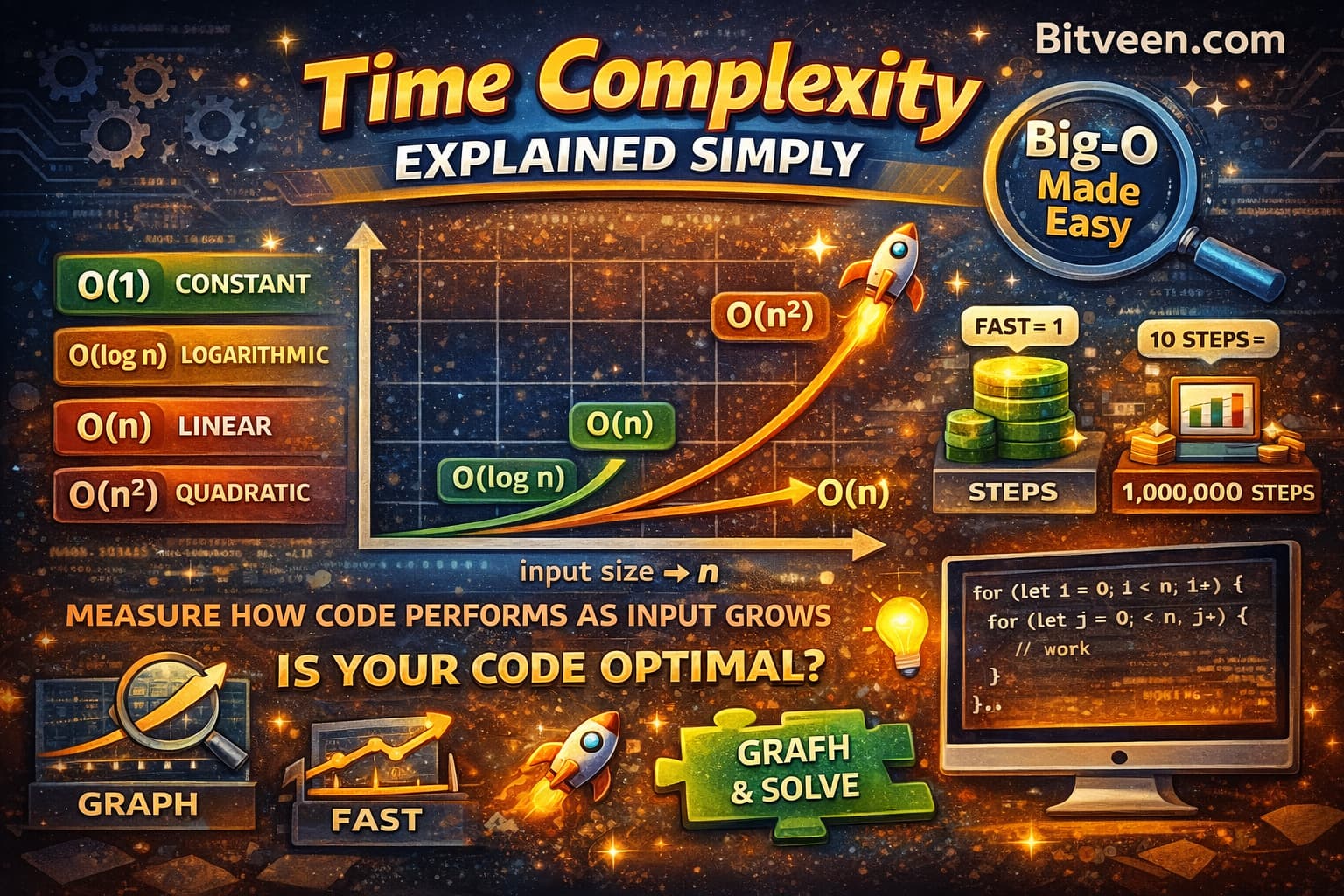
📉 Visual Growth Comparison (Explained Inside)
Input Size (n) →
--------------------------------------------------------------

O(1)
→  ●────────●────────●────────●
   same steps regardless of input (constant time)

O(log n)
→  ●───●────●─────●──────●
   reduces problem size by half each step (Binary Search)

O(n)
→  ●────●────────●──────────●
   checks every element one by one (Linear Search)

O(n²)
→  ●────────●──────────────●──────────────●
   nested loops, comparisons grow very fast 🚀
⚡ One-Line Interpretation (add below diagram)
As input grows, O(1) stays flat, O(log n) grows slowly, O(n) grows steadily, and O(n²) grows very fast.
n = 10

O(1)     → 1 step
O(log n) → ~3 steps
O(n)     → 10 steps
O(n²)    → 100 steps 😨
Input Size →      small        medium        large

O(1)           constant     constant      constant
O(log n)       low          low           medium
O(n)           low          medium        high
O(n²)          low          high          very high 🚀
⚠️ Why This Matters
Let’s compare:
- O(n) → 1,000 steps
- O(n²) → 1,000,000 steps
👉 Same problem
👉 Massive difference in performance
🧠 Interview Insight
Interviewers don’t just check if your code works.
They ask:
- Can you optimize this?
- Can you reduce time complexity?
👉 A good solution = correct
👉 A great solution = efficient
❌ Common Mistakes
❌ Focusing only on output
Ignoring performance
❌ Not analyzing loops
Every loop impacts complexity
❌ Ignoring worst case
Always think worst-case scenario
🧩 Quick Practice
👉 What is the time complexity?
for (let i = 0; i < n; i++) {
  console.log(i);
}
👉 Answer: O(n)
🚀 What’s Next?
Now that you understand performance…
👉 Next blog:
“Space Complexity Explained (Memory Matters Too)”
✍️ Closing Thought
“Writing code is easy. Writing efficient code is what makes you a great developer.”