Blog 2: What is a Data Structure and Why Do We Need It?
Data Structures are the backbone of efficient programming. Learn how to store, organize, and access data effectively to build scalable applications. Start your DSA journey with real-world understanding and practical insights. #DSA #DataStructures #Coding #Programming #Algorithms #Tech

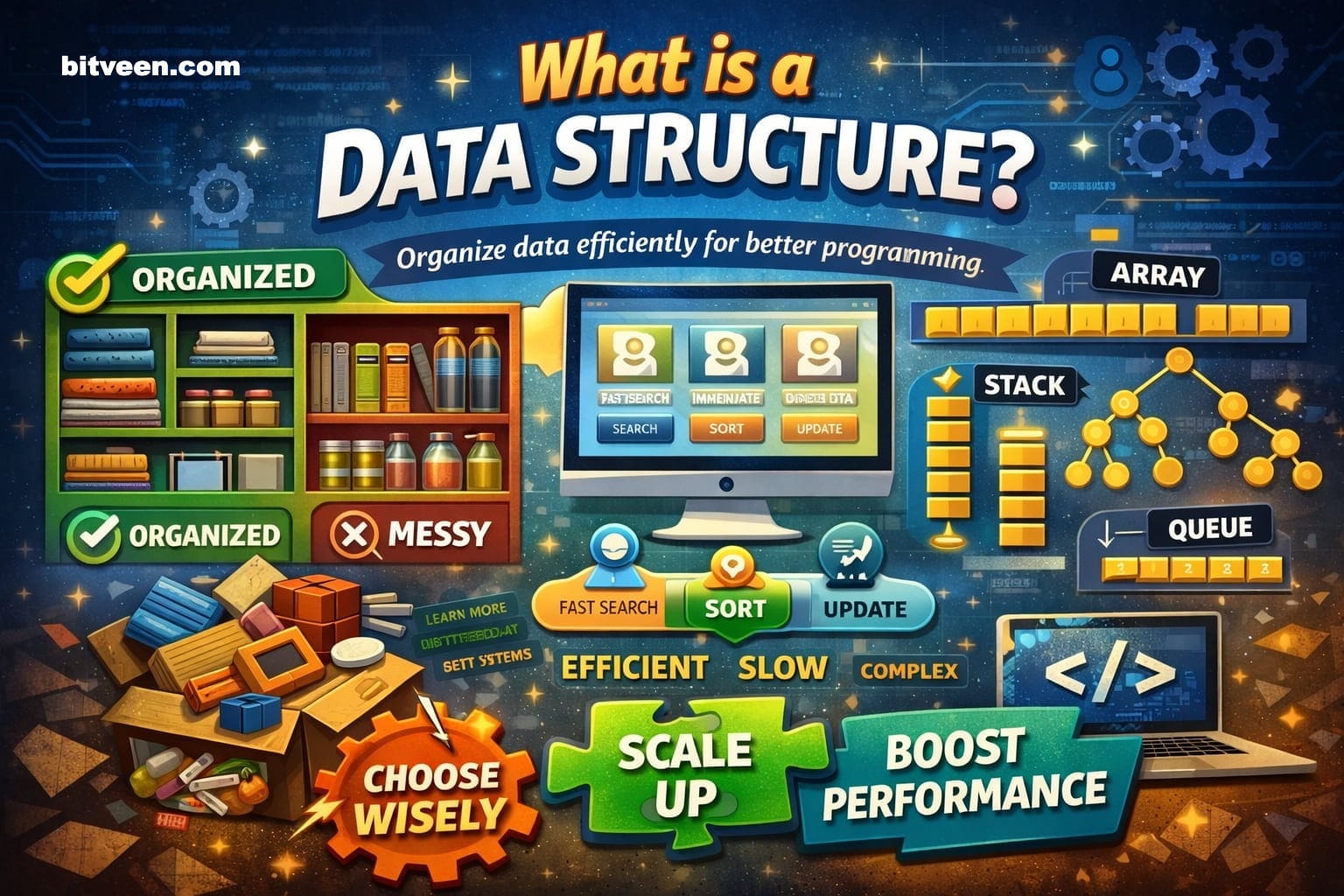
🧠 Introduction
In the previous blog, we learned how to think like a programmer.
Now the next question is:
Once you know how to think… how do you store and organize data efficiently?
This is where Data Structures come into play.
📦 What is a Data Structure?
A Data Structure is a way to:
- Store data
- Organize data
- Access data efficiently
👉 Simple definition:
“A data structure is a way to organize data so that it can be used effectively.”
🧊 Real-Life Analogy
Think of your house 🏠
- Clothes → Stored in a cupboard
- Books → Stored on a shelf
- Groceries → Stored in containers
👉 You don’t just throw everything in one place.
Because if you do:
- You waste time searching
- You create confusion
👉 Same happens in programming.
⚡ Why Do We Need Data Structures?
Let’s say you have 1 million users in your app.
Now you want to:
- Search a user
- Sort users
- Update user data
If your data is not organized properly:
❌ Operations become slow
❌ Code becomes messy
❌ System becomes inefficient
👉 Data Structures help you:
- Improve performance
- Reduce complexity
- Scale applications
🔍 Types of Data Structures (High-Level)
We’ll go deep later, but here’s a quick view:
🔹 Linear Data Structures
- Elements arranged in sequence
- Example:
- Array
- Linked List
- Stack
- Queue
🔹 Non-Linear Data Structures
- Data is not sequential
- Example:
- Tree
- Graph
🎯 Choosing the Right Data Structure
This is where real skill comes in.
👉 Example:
- Need fast search → Use Binary Search Tree / Hashing
- Need ordered data → Use Array / List
- Need LIFO → Use Stack
👉 Wrong choice = bad performance
⚠️ Common Beginner Mistakes
❌ Using arrays everywhere
Arrays are simple, but not always efficient
❌ Ignoring time complexity
Different structures = different performance
❌ Not thinking about scale
What works for 10 items may fail for 10 lakh
🧠 Real Industry Insight
In real projects:
- Databases use B-Trees
- Caching uses HashMaps
- Messaging systems use Queues
👉 You are already using Data Structures — even if you don’t realize it.
🚀 What’s Next?
Now that you understand what Data Structures are…
👉 Next blog:
“Understanding Arrays – The Simplest Data Structure”
✍️ Closing Thought
“Good programmers write code.
Great programmers choose the right data structure.”